


Diabetes mellitus is one of the most common diseases with the tendency to increase in incidence and spoil the statistics.The symptoms of diabetes mellitus do not appear overnight;the process is chronic, with increase and worsening of endocrine and metabolic disorders.True, the onset of type 1 diabetes differs significantly from the early stage of type 2 diabetes.
Among all endocrine diseases, diabetes definitely holds the lead and accounts for more than 60% of all cases.Furthermore, disappointing statistics show that 1/10 of “diabetics” are children.
The probability of contracting the disease increases with age and, therefore, every ten years the size of the group doubles.This is due to increased life expectancy, improved early diagnosis methods, decreased physical activity and an increase in the number of overweight people.
Types of diabetes
Many people have heard of a disease such as diabetes insipidus.So that the reader does not subsequently confuse the diseases called “diabetes”, it will probably be useful to explain their differences.
Diabetes insipidus
Diabetes insipidus is an endocrine disease that occurs as a result of neuroinfections, inflammatory diseases, tumors, intoxications and is caused by the insufficiency and sometimes the complete disappearance of ADH-vasopressin (antidiuretic hormone)
This explains the clinical picture of the disease:
- Constant dryness of the oral mucosa, incredible thirst (a person can drink up to 50 liters of water in 24 hours, stretching the stomach to a large size);
- Isolation of a huge amount of light unconcentrated urine with low specific gravity (1000-1003);
- Catastrophic weight loss, weakness, decreased physical activity, digestive system disorders;
- Characteristic skin changes (“parchment” skin);
- Atrophy of muscle fibers, weakness of the muscular system;
- Development of dehydration syndrome in the absence of fluid intake for more than 4 hours.
In terms of complete recovery, the disease has a poor prognosis;working capacity is significantly reduced.
Brief anatomy and physiology
An unpaired organ, the pancreas, performs a mixed secretory function.Its exogenous part carries out external secretion, producing enzymes involved in the digestion process.The endocrine part, which is entrusted with the mission of internal secretion, produces various hormones, including:insulin and glucagon.They are essential to ensure the consistency of sugar in the human body.
The endocrine section of the gland is represented by the islets of Langerhans, made up of:
- A cells, which occupy a quarter of the total islet space and are considered the site of glucagon production;
- B cells, which occupy up to 60% of the cell population, synthesize and store insulin, whose molecule is a polypeptide of two chains, which carries 51 amino acids in a certain sequence;
- D cells that produce somatostatin;
- Cells that produce other polypeptides.
So the conclusion suggests itself:Damage to the pancreas and islets of Langerhans, in particular, is the main mechanism that inhibits insulin production and triggers the development of the pathological process.
Particular types and forms of the disease
The lack of insulin leads to reduced sugar constancy (3.3 – 5.5 mmol/l)and contributes to the formation of a heterogeneous disease called diabetes mellitus (DM):
- Complete absence of insulin (absolute deficiency) is formed.insulin-dependentpathological process, which is calledtype I diabetes mellitus (IDDM);
- The lack of insulin (relative deficiency), which triggers a disorder of carbohydrate metabolism in the initial stage, slowly but surely leads to the developmentnot insulin-dependentdiabetes mellitus (NIDDM), which is calledtype II diabetes mellitus.
Due to the disturbance in the use of glucose by the body and, as a consequence, its increase in the blood serum (hyperglycemia), which, in principle, is a manifestation of the disease, over time signs of diabetes mellitus begin to appear, that is, a total disorder of metabolic processes at all levels.
In addition to type 1 and type 2 diabetes, there are special types of this disease:
- Secondary diabetesresulting from acute and chronic inflammation of the pancreas (pancreatitis), malignant neoplasms in the parenchyma of the gland, liver cirrhosis.Numerous endocrine disorders accompanied by excessive production of insulin antagonists (acromegaly, Cushing's disease, pheochromocytoma, thyroid diseases) lead to the development of secondary diabetes.Many drugs used for a long time have a diabetogenic effect: diuretics, some antihypertensive drugs and hormones, oral contraceptives, etc.;
- Diabetes in pregnant women (gestational),caused by the peculiar mutual influence of the hormones of the mother, the child and the placenta.The fetal pancreas, which produces its own insulin, begins to inhibit the production of insulin by the maternal gland, as a result of which this special form is formed during pregnancy.However, with proper control, gestational diabetes usually goes away after delivery.Subsequently, in some cases (up to 40%) in women with a similar history of pregnancy, this fact can threaten the development of type II diabetes mellitus (within 6-8 years).
Why does “sweet” disease occur?
The “gentle” disease forms a rather “heterogeneous” group of patients, so it becomes obvious that IDDM and its non-insulin-dependent “brother” have genetically different origins.There is evidence of a connection between insulin-dependent diabetes and the genetic structures of the HLA (major histocompatibility complex) system, in particular with some genes of the D region loci. For NIDDM such a relationship was not observed.
For the development of type I diabetes mellitus, genetic predisposition alone is not sufficient;the pathogenetic mechanism is triggered by provoking factors:
- Congenital deficiency of the islets of Langerhans;
- Unfavorable influence of the external environment;
- Stress, nervous stress;
- Traumatic brain injuries;
- Pregnancy;
- Infectious processes of viral origin (flu, mumps, cytomegalovirus infection, Coxsackie);
- Tendency to constantly overeat, resulting in excess fat deposits;
- Abuse of confectionery products (those with a sweet tooth run greater risks).
Before addressing the causes of type II diabetes mellitus, it would be appropriate to focus on a very controversial question: who suffers from it more often: men or women?
It is established that nowadays the disease affects women more often, even if in the 19th century diabetes was a "privilege" of the male sex.By the way, now in some Southeast Asian countries the presence of this disease in men is considered predominant.
Predisposing conditions for the development of type II diabetes mellitus include:
- Changes in the structural structure of the pancreas as a result of inflammatory processes, as well as the appearance of cysts, tumors, hemorrhages;
- Age after 40 years;
- Excess weight (the most important risk factor for NIDDM!);
- Vascular diseases caused by the atherosclerotic process and arterial hypertension;
- In women, pregnancy and birth of a child with high body weight (more than 4 kg);
- Have relatives with diabetes;
- Strong psycho-emotional stress (adrenal hyperstimulation).
The causes of the disease of different types of diabetes in some cases coincide (stress, obesity, influence of external factors), but the beginning of the process in type 1 and type 2 diabetes is different, moreover,IDDM is the province of children and youth, and non-insulin-dependent people prefer the elderly.
Why do you want to drink so much?
Characteristic symptoms of diabetes mellitus, regardless of form and type, can be presented as follows:

- Dryness of the oral mucous membranes;
- Thirst practically impossible to quench, associated with dehydration;
- Excessive formation of urine and its excretion by the kidneys (polyuria), which leads to dehydration;
- An increase in the concentration of glucose in the blood serum (hyperglycemia), due to the suppression of the use of sugar by peripheral tissues due to insulin deficiency;
- The appearance of sugar in the urine (glucosuria) and ketone bodies (ketonuria), which are normally present in negligible quantities, but in diabetes mellitus they are intensely produced by the liver and when expelled from the body are found in the urine;
- Increased content of urea and sodium ions (Na.) in the blood plasma (in addition to glucose).+);
- Weight loss, which in case of decompensation of the disease is a characteristic feature of the catabolic syndrome, which develops due to the breakdown of glycogen, lipolysis (mobilization of fats), catabolism and gluconeogenesis (transformation into glucose) of proteins;
- Violation of indicators of the lipid spectrum, increase in total cholesterol due to the low-density lipoprotein fraction, NEFA (non-esterified fatty acids), triglycerides.The increasing lipid content begins to be actively sent to the liver and there they are intensively oxidized, which leads to the excessive formation of ketone bodies (acetone + β-hydroxybutyric acid + acetoacetic acid) and their further entry into the blood (hyperketonemia).An excessive concentration of ketone bodies threatens a dangerous condition calleddiabetic ketoacidosis.
Therefore, the general signs of diabetes can be characteristic of any form of the disease, however, in order not to confuse the reader, it is still necessary to note the features inherent in one or another type.
Type I diabetes mellitus is a "privilege" of young people
IDDM is characterized by an acute onset (weeks to months).The signs of type I diabetes mellitus are pronounced and are manifested by clinical symptoms typical of this disease:
- Sudden weight loss;
- Unnatural thirst, a person simply cannot get drunk, even if he tries to do so (polydipsia);
- Large amounts of urine excreted (polyuria);
- Significant excess of the concentration of glucose and ketone bodies in the blood serum (ketoacidosis).At the initial stage, when the patient may not yet be aware of his problems, the development of diabetic (ketoacidotic, hyperglycemic) coma is very likely - an extremely life-threatening condition, therefore insulin therapy is prescribed as early as possible (as soon as diabetes is suspected).

In most cases, after the use of insulin, metabolic processes are compensated,The body's need for insulin drops dramatically and a temporary "recovery" occurs.However, this state of short-term remission should not relax either the patient or the doctor, since after a certain period of time the disease will remind itself again.Insulin requirements may increase with the duration of the disease but, generally, in the absence of ketoacidosis, they do not exceed 0.8-1.0 U/kg.
Signs indicating the development of late complications of diabetes (retinopathy, nephropathy) may appear after 5-10 years.The main causes of death from IDDM include:
- Terminal renal failure, which is a consequence of diabetic glomerulosclerosis;
- Cardiovascular disorders are complications of the underlying disease, which occur somewhat less frequently than kidney disorders.
Illnesses or age-related changes?(type II diabetes)
NIDDM develops over many months and even years.When problems arise, the person takes them to different specialists (dermatologist, gynecologist, neurologist...).The patient does not even suspect that several diseases, in his opinion: furunculosis, skin itching, fungal infections, pain in the lower extremities are signs of type II diabetes mellitus.Patients get used to their condition, and diabetes continues to develop slowly, affecting all systems and mainly blood vessels.
NIDDM is characterized by a stable and slow course, usually without a tendency to ketoacidosis.
Treatment of type 2 diabetes usually begins with a diet that limits easily digestible (refined) carbohydrates and the use of sugar-reducing medications (if necessary).Insulin is prescribed if the disease has progressed to the stage of serious complications or if there is resistance to oral medications.
The main cause of death in patients with NIDDM is recognized as cardiovascular disease resulting from diabetes.As a rule, this is a heart attack or stroke.
Treatments for diabetes mellitus
The basis of therapeutic measures aimed at compensating diabetes mellitus is represented by three fundamental principles:

- Compensation for insulin deficiency;
- Regulation of endocrine and metabolic disorders;
- Prevention of diabetes, its complications and their timely treatment.
The implementation of these principles is based on 5 main positions:
- Nutrition for diabetes mellitus plays the role of “first violin”;
- The diet is followed by a system of physical exercises, adequate and individually selected;
- Sugar-lowering drugs are primarily used to treat type 2 diabetes;
- Insulin therapy is prescribed if necessary for NIDDM, but is essential in type 1 diabetes;
- Train patients in self-monitoring (ability to draw blood from a finger, use a glucometer, administer insulin without assistance).
Laboratory control over these positions indicates the degree of compensation after the following biochemical studies:
| Indicators | Good level of compensation | Satisfying | Bad |
|---|---|---|---|
| Fasting glucose level (mmol/l) | 4.4 – 6.1 | 6.2 – 7.8 | Ø7.8 |
| Blood sugar content 2 hours after a meal (mmol/l) | 5.5 – 8.0 | 8.1 – 10.0 | Ø 10.0 |
| Percentage of glycosylated hemoglobin (HbA1, %) | <8,0 | 8.0 – 9.5 | Ø 10.0 |
| Serum total cholesterol (mmol/l) | <5.2 | 5.2 – 6.5 | Ø6.5 |
| Triglyceride level (mmol/l) | <1,7 | 1.7 – 2.2 | Ø2.2 |
The important role of diet in the treatment of NIDDM
Nutrition for diabetes mellitus is very well known even to people far from diabetes mellitus, table number 9. In the hospital for any disease, from time to time we hear about a special diet, which is always in separate pots, differs from other diets and is distributed after saying a certain password: “I have the ninth table”.What does all this mean?How is this mystery diet different from all the others?
One should not be mistaken, caring for a diabetic by taking away his “porridge”, telling him that he is being deprived of all the joys of life.The diabetes diet isn't all that different from the diet of healthy people;patients receive the necessary amount of carbohydrates (60%), fats (24%) and proteins (16%).

Nutrition for diabetes involves replacing refined sugars in foods with slowly breaking down carbohydrates.Sugar sold in general stores and confectionery products based on it fall into the category of prohibited foods.
As for nutritional balance, everything is strict here: a diabetic must necessarily consume the required amount of vitamins and pectins, which must be at least 40 grams.per day.
Strictly individual physical activity
Physical activity for each patient is selected individually by the attending physician, taking into account the following points:

- Age;
- Symptoms of diabetes;
- The severity of the pathological process;
- The presence or absence of complications.
The physical activity prescribed by the doctor and carried out by the "department" should promote the "burning" of carbohydrates and fats without involving insulin.Its dose, necessary to compensate for metabolic disorders, significantly decreases, which should not be forgotten, since by preventing an increase in blood sugar levels, an undesirable effect can be achieved.Adequate physical activity reduces glucose, the dose of insulin administered breaks down the remaining glucose and, consequently, a decrease in sugar levels below acceptable values (hypoglycemia).
So,dosing of insulin and physical activity requires a lot of attention and accurate calculation,so that, complementing each other, together we do not exceed the lower limit of normal laboratory parameters.
Or maybe try folk remedies?
Treatment of type 2 diabetes mellitus is often accompanied by the patient's search for folk remedies that can slow down the process and delay the time of taking dosage forms as much as possible.
Despite the fact that our distant ancestors practically did not know about this disease, there are folk remedies for the treatment of diabetes mellitus, but we should not forget about itinfusions and decoctions prepared with various plants are helpful.The use of home remedies for diabetes does not exempt the patient from following a diet, monitoring blood sugar, visiting a doctor and following all his recommendations.

To combat this pathology at home, quite well-known folk remedies are used:
- Bark and leaves of the white mulberry;
- Oat grains and husks;
- Walnut partitions;
- Bay leaf;
- Cinnamon;
- Acorns;
- Nettle;
- Dandelion.
When diet and folk remedies no longer help...
The so-called first generation drugs, widely known at the end of the last century, have become a thing of the past and have been replaced by new generation drugs, which make up the 3 main groups of antidiabetic drugs produced by the pharmaceutical industry.

The endocrinologist decides which remedy is suitable for this or that patient.And so that patients do not self-medicate and do not decide to use these diabetes drugs at their own discretion, we will provide several illustrative examples.
Sulfonylurea derivatives
Currently, second generation sulfonylurea derivatives are prescribed, which act for 10 hours to 24 hours.Patients usually take them 2 times a day, half an hour before meals.
These drugs are absolutely contraindicated in the following cases:
- Type 1 diabetes mellitus;
- Diabetic coma, hyperosmolar, lactic acid;
- Pregnancy, childbirth, breastfeeding;
- Diabetic nephropathy accompanied by impaired filtration;
- Diseases of the hematopoietic system with a concomitant decrease in white blood cells - leukocytes (leukocytopenia) and the platelet component of hematopoiesis (thrombocytopenia);
- Severe infectious and inflammatory liver lesions (hepatitis);
- Diabetes complicated by vascular pathology.

In addition, the use of drugs in this group may threaten the development of allergic reactions, manifested by:
- Skin itching and urticaria, which sometimes reach Quincke's edema;
- Digestive system disorders;
- Changes in the blood (decreased levels of platelets and leukocytes);
- Possible impairment of the functional capabilities of the liver (jaundice due to cholestasis).
Antihyperglycemic agents of the biguanide family
Biguanides (guanidine derivatives) are actively used to treat type 2 diabetes mellitus, often by adding sulfonamides to them.They are very rational for use by obese patients, however, for people with liver, kidney and cardiovascular pathologies, their use is severely limited, switching to more gentle drugs from the same group or α-glucoside inhibitors, which inhibit the absorption of carbohydrates in the small intestine.
The following are considered absolute contraindications to the use of biguanides:
- IDDM (type 1 diabetes mellitus);
- Significant weight loss;
- Infectious processes, regardless of location;
- Surgical interventions;
- Pregnancy, childbirth, breastfeeding;
- Comatose states;
- Liver and renal disease;
- Oxygen deficiency;
- Microangiopathy (2-4 degrees) with impaired vision and renal function;
- Trophic ulcers and necrotic processes;
- Poor circulation in the lower limbs due to various vascular pathologies.
Insulin treatment
From the above it is obviousInsulin is the primary treatment for type 1 diabetes, all medical emergencies, and serious complications of diabetes.NIDDM requires the appointment of this therapy only in cases of forms requiring insulin, when correction by other means does not give the desired effect.
Modern insulins, called monocompetent, represent two groups:
- Monocompetent pharmacological forms of the human insulin substance (semisynthetic or recombinant DNA), which undoubtedly have a significant advantage over drugs of porcine origin.They have practically no contraindications or side effects;
- Monocompetent insulins obtained from porcine pancreas.These drugs, compared to human insulins, require an increase in the drug dose of approximately 15%.
Diabetes is dangerous due to complications
Due to the fact that diabetes is accompanied by damage to many organs and tissues, its manifestations can be found in almost all systems of the body.The complications of diabetes mellitus are:
- Pathological changes in the skin: diabetic dermopathy, necrobiosis lipoidica, furunculosis, xanthomatosis, fungal skin infections;
- Osteoarticular diseases:
- Diabetic osteoarthropathy (Charcot joint - alteration of the ankle joint), occurring against the background of microcirculatory and trophic disorders, accompanied by dislocations, subluxations, spontaneous fractures preceding the formationdiabetic foot;
- Diabetic hair disease, characterized by stiffness of the joints of the hands, which often develops in children with diabetes;
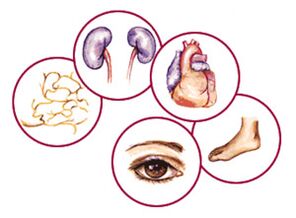
- Respiratory diseases: long termprolonged bronchitis, pneumonia,increased incidence of tuberculosis;
- Pathological processes affecting the digestive organs:diabetic enteropathy, accompanied by increased peristalsis, diarrhea (up to 30 times a day), loss of body weight;
- Diabetic retinopathy– one of the most serious complications, characterized by damage to the visual organs;
- It is considered the most common complication of diabetes mellitusdiabetic neuropathyand its variety -polyneuropathy, reaching 90% of all forms of this pathology.Diabetic polyneuropathy is a common conditiondiabetic foot syndrome;
- A pathological condition of the cardiovascular system, which in most cases causes death due to diabetes mellitus.Hypercholesterolemia and vascular atherosclerosis, which in diabetes begin to develop at a young age, inevitably lead to heart and vascular diseases (coronary heart disease, myocardial infarction, heart failure, cerebrovascular accident).
Prevention
Measures to prevent diabetes mellitus are based on the causes that cause it.In this case it is appropriate to talk about the prevention of atherosclerosis and arterial hypertension, including the fight against excess weight, bad habits and food addictions.

Prevention of complications of diabetes mellitus involves preventing the development of pathological conditions resulting from the diabetes itself.Correcting blood serum glucose, following a diet, adequate physical activity and following the doctor's recommendations will help delay the consequences of this rather terrible disease.